

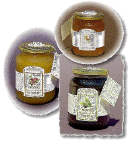
 Honey
is the product of honeydew mixed
with bees’ bodily fluids.
Honey
is the product of honeydew mixed
with bees’ bodily fluids.
If the honey is light or dark, fluid or thick depends from different factors which influence the nectar’s composition:
Which plants it comes from, how the bloom was, which temperature, light, air, sun - and wind conditions predominated, if the ground was wet or dry, rocky or sandy, rich or poor in minerals.
Sugar, acids, minerals and vitamins, colouring and flavouring of the nectar influence the honey’s final characteristic.
Honey is mostly (70/80 %) made of natural sugars, fructose and glucose. In addition to that it contains minerals such as calium, calcium, natrium, magnesium and others.
These minerals are of vital importance for the human organism. Honey contains for example small amounts of vitamin B1,B2, B6,C
Important are enzymes such as “invertase” (which splits sugar in the honey and makes it easily digestible) and “diastase” ( a ferment which splits oxygen) and “katalase”.

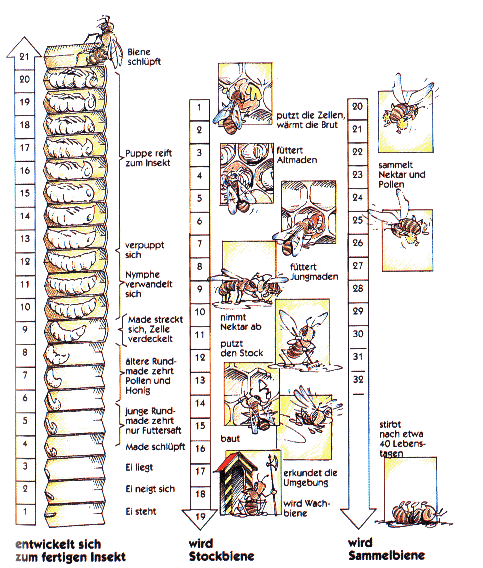
Bees colonies consist of three categories:
-
The queen bee, the biggest bee in the hive is the only fertile bee. Her duty is to rule the colony and to produce descendants by lying eggs day-in day-out. It’s her who decides whether the eggs will turn into bees or drones. She doesn’t have any gadgets for collecting nectar, doesn’t produce wax and is always fed by the other bees. Her life expectancy is of 3 years.
-
The drones are the male bees. Their duty is to fertilise the queen bee. After their job is done they are killed or chased out of the hive.
-
Working bees, whose number can reach the 50,000 in a bee-hive, do all the necessary work for the colony:
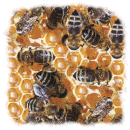 they produce the honey, propolis and the royal jelly,
build the honeycomb out of wax, fetch the nectar and grow the young.
They feed the queen and
defend the hive from unwanted guests.
they produce the honey, propolis and the royal jelly,
build the honeycomb out of wax, fetch the nectar and grow the young.
They feed the queen and
defend the hive from unwanted guests.

In antiquity honey was seen as natural cure which gave humans beauty and longevity. Greek athletes esteemed it as energiser, Homer called it “lovely Gods’food “ and the greek physician Hippocrates (460 a.d.) and his students developed more than 300 recipes for treatment. They knew honey could heal festerings, lower fever, cool and thinnen blood.
When asked how to become old in such good health the 100 years old philosopher Demokrit answered shortly: “ Take externally oil and internally honey.” Phythagoras followers highly valued honey as a remedy against sore eyes and poisoning. By the way, Pythagoreans are said to have nourished themselves by bread and honey only and to have grown as old as the hills.
Honey was highly regarded by the Romans as well. From a cooking book from Apicus (1st century) we take that every course at roman banquettes was accompanied by honey: it was served to fish, meat and poultry, in honey roasted nuts and pine-kernels were eaten as side-dish .Cakes and desserts were sweetened with honey, it was drank as cold or hot wine. It was beloved by the Romans, so that internal production wasn’t sufficient and prices grew to the stars. Consequently it was imported from the Greek isles and from Spain and claimed as tribute from the besieged enemies: e.g. the Romans asked 100,000 kg of honey a year from the defeated Corsicans. Caesar is said to have had the principle “ few fat, lots of honey “. In addition to the healthy potions made of honey, the Romans knew also about the Spanish recipes for mead and the Gallic and German mix of honey and barleycorn (beer).
-
That honey strengthens bodily defences and is useful to get over coughs and sneezes is commonly known. People value it as household remedy against fever, sleeping problems, inflamed gums and hay-fever as well.
-
Honey is a wonderful medium of transport as after digesting it is immediately turned into energy, for its natural sugars only need few enzymes in order to be split
-
A glass of water with 2 teaspoons of honey and a teaspoon of vinegar is a wonderful energiser against weariness and tiredness
-
Already Hippocrates knew: honey produces thermal energy, cleans wounds and ulcers, softens sore lips, heals boils and watering wound
-
Never put honey in boiling liquids, for its contents of enzymes and vitamins will be destroyed by overheating. Don’t heat it over 40-45°C. If you want to liquefy crystallised honey put the glass in a double-boiler at about 40°C